As already explained in the comments by Blake, it’s fact that the rumors about the renaming of IceRocket came to an end. Mark Cuban won’t use the name „BlogScour„, but instead they will focus on some more IceRocketing. ;)
Robert Basic left my daily reads at the M-E-X Blog. He’s been one of the (if it’s ever appropriate) A-Listers of the German Blogosphere. While I know some background information that lead to his depature, I’m not going to spread any false rumors here. The good thing is: He is back!
I’m surely going to read him in the future and added already his links to my RSS reader and blogroll, but I’m definately interested in the future of the M-E-X Blog, too. I’m not sure what will happen there, but let’s keep an eye on it.
(BTW Robert – can you please update my link in your blogroll? It directs to the old account…)
Those who want it, those who need it:
Hugh MacLeod and Alistair Shrimpton have created this new central database for blog-designers as a wiki. And no fear, they allow those who design websites professionally to be added to the list.
People are always asking the both of us, „Where can I find a good blog designer?“ We thought it was time to come up with an easy-to-use solution that anybody on the planet could make good use of. If you know anyone who qualifies, please spread the word. Thanks.
I remember there’s been some similiar attempt by the Design Directory which covers almost every kind of design and not just blogs. On the other hand, why searching for a good designer if you can’t create a design on your own? Okay, that’s a company problem and hardly the problem of individual blog authors… ;)
[via ProBlogger]
BlogKits published an anonymous Blog Advertising Survey. While they offer quite obscure questions such as „What is the primary reason you have a blog?“, they clearly try to figure out on how the blog authors use ads to collect money within the blogs and rss feeds. What strikes me most is that they primarily choose Google Adsense and BlogAds as examples… „probably there goes their pee„. But in the end, the entire survey is not profound. I’ve seen good surveys and worked with survey software (SPSS) – but their survey leaves me with doubtful results. [via LightWithin (won’t you offer a Trackback?)]
This morning I’ve asked myself about what kind of posts are more attractive for the readers of my blog posts. I ended up creating my own quite subjective list of what attracts me to continue to read. This includes a simple hierarchy of these five nice standards.
1. Images
An entry with at least one image in the first paragraph is quite tempting for further reading. Why shouldn’t I continue to read an article if there’s already a picture, image or screenshot that directs me to the main idea behind the author’s writing? If it’s only one image, the better it is placed in the first paragraph aligned to the side, and if it’s a screenshot, it’s preferably placed between the first and second paragraph. More than two images are listed with thumbnails below the article or in paragraph alignment. However, a good separation between posts that do include images and posts that do not rely on image shows me that an author can separate between the usefulness and the redundancy of images.
2. Quotes
Once there’s an entry that separates a quote from the original text, the more I value the author’s work of acknowledging other people. On the other hand, while blogging about a specific event which can be seen on TV, it’s quite impossible to quote or sometimes link this source.
3. Links
Now while speaking about linking, I personally require links for most articles. As much as the links enhance the usability of articles, to link to other resources becomes a major factor for reading a post. In concern to quotes, this is imperative and must be done (next to trackbacks). Quoting without sources? A paper without footnotes? Not worth reading…
4. Media Casting
I like to listen to or view any kind of media including all kinds of Media Casts even if it does not originate from the author (just as a link to another ressource). One thing I do hate is if these multimedia files are embedded into the blog and start to auto play. One thing I like is a small screenshot of the video and the information about the size of the file. Last night we’ve been downloading the video to the iFlea, and it happened to be larger than we expected due to our current ISDN lag.
5. Text
Well, that’s what the blog is all about. But unless the text is part of an academic paper or a longer useful post including reports, documentations, (breaking-)news – it’s clearly showing in my behavior that I don’t read an endless portion of „yadda yadda“. Three paragraphs are the maximum for me to be attracted to the daily burnouts of some folks‘ brains. I’m not going to judge how the text is written or what kind of style the author chooses, since I do prefer language and lingo – but not slang or crap-lingo as found in the „yadda yadda“. One last thing: Paragraphs!

As found on Napsterization, Mary Hodder wrote a long article concerning her methods on how to search for blogs. The article offers a comparison of URL lookups for Bloglines, Blogpulse, Feedster, Pubsub and Technorati – or you can simply grab the information by downloading the small version as comfortable PDF document. The author intends this to be the start of a a multipart series which will include the topics of key word search, subscription (watchlist) search, spam, and special services.
[via Blogspotting]
The Blogosphere is troubled about the future these days. Already a few days ago, Jeremy Zadow wondered about the peak of Blogging.
Blogging now feels like on-line shopping around the year 2000 or 2001. Most of us no longer think it’s a miracle that it works, a new thing, scary, difficult, hard to understand, etc.
So I’m starting to wonder what the timeline might look like. Roughly when do you expect blogging to go from being „the new thing“ or „the thing that changes/reinvents X“ to just another part of daily life for a bunch of people? …just like on-line shopping.
Just a few hours later, Steve Rubel asked about the future and made some predictions:
1. The Long Tail – small players can collectively make up a market that rivals the giants. As Seth says, small is the new big. This applies equally for journalism as well as for marketers.
2. The Read Write Web/Web 2.0 – technologies like Ajax will make the web more dynamic, turning it into a full-fledged platform. Wither the desktop.
3. Timeshifting – consumers will increasingly want to devour media on their own time, on the mobile device of their choice and without commercials
4. Collaborative Categorization – consumers, using technology, will create their own taxonomies that make it easier to find information. This is sometimes called tagging, social search or folksonomies. However, this is just the beginning.
5. Citizen Marketing – consumers will organize – either on their own or with the help of companies – to evangelize products they love and vilify those they don’t
6. The Daily Me – it’s finally here; RSS, AI and personal search tools will make it easier for people to seek out only the news they care about and tune out all else
7. It’s All a Conversation – as journalism becomes a conversation, so will marketing – just like Cluetrain said.
8. What’s Inside is Outside – mobile devices and consumer generated media mean that whatever a single eye beholds so can the world.
9. Trust Marketing – people will increasingly use social networking technology to tune in messages from individuals they trust (including citizen journalists) and tune out everyone else
10. Decentralized Communication – armies of individual employees will use technology to become the voice of every company; like it or not. The solo singer is dead. Long live the chorus.
The translated german version can be found on Mario Sixtus‘ blog, and Björn Ognibeni expects some ideas by Renee Hopkins Callahan and James Cherkoff to become reality.
I consider these trends as much as possible as future predictions become reality. There’s a chance these things will develop as predicted, but a chance of even height strikes against this. I’m not keen on searching for a specific successor of blogs or social networking software, but I’m willing to try it out once it exists. Unless I don’t make this kind of major step that affects the digitalized human beings, I’m just going to await these changes.
It sounds like a joke, but as recently reported, Mark Cuban plans to rename the nice search engine „IceRocket“ to „BlogScour“. I enjoyed the service quite alot as it offers some small but unique blog-search routines which can compete with any kind of googling the world. However, the new name sounds like a bawl of useless laughter. I don’t need to see „blog“ in every place all over the screen. Just because the new brand includes the word „blog“, it’s not a real relaunch. I prefer IceRocket as it is.
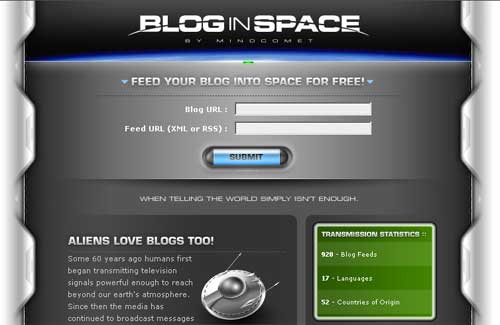
I’ve done it already last evening: I registered MikeSchnoor.com for a signal-trip to space. From now on, any kind of events will be noted by aliens – unless they’ve not infiltrated the human race already! On the other hand, it’s at least some controversy to the endless stream of TV signals which already document a massive information of war, terror, pain and most evil moments of human beings. What we are able to do can be easily received in the entire universe – it just takes time.
The new service Blog in Space gives us the opportunity to do all this fancy stuff. But in the end, I do wonder about the following: Why may I not see the list of blogs/feeds which have been registered at their site? Where’s their proof of sending a signal which is strong enough to compete with i.e. Television signals? How do they finance such kind of endless transponder message?
A very important thing to consider while blog-reading the dailies: The Electronic Frontier Foundation has created the „Blog-a-thon“.

We want to hear about your „click moment“ — the very first step you to took to stand up for your digital rights — whether it was blogging about an issue you care about, participating in a demonstration, writing your representatives, or getting involved with EFF. As a thank you, we’ve enlisted an independent panel of judges to choose from among your posts for „Most Inspirational,“ „Most Humorous,“ and „Best Overall.“ At the end of the Blog-a-thon, we’ll announce the names of the three bloggers with the best posts on our website and in our weekly newsletter, EFFector. We’ll also publish the three best posts on our site and send the authors a blogging „kit“ as an extra thank you: an EFF bloggers‘ rights T-shirt, special EFF-branded blogger pajama pants, a pound of coffee, and a pair of fuzzy slippers.
You can basically post about anything you’d like between July 19th and 26th on your blog. This includes blog posts, podcasts, videos, images or letters as long as you tag it as a Blog-a-thon post by adding this special set of HTML code:
Blog-a-thon tag:
<a href="http://eff.org/bloggers/eff15" rel="tag">EFF15</a>
<!--tag end -->
I guess the non-textual media has to be published within a blog to tag the media file with the text code. More of the simple instructions can be found on their event’s site.